• Dr Aparna Pandya
  • 31 May, 2022

Tooth gems-Smile like a star

Authour: Dr Aparna Pandya (Mrs. India Vivacious2019)

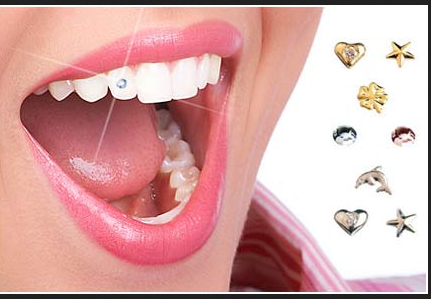
“Life isn’t perfect but your jewellery can be, and what is better than a sparkle when you smile.” So the next time your patient asks for a sparkling smile, here is what you can give-Tooth jewellery. It is simply the procedure of placing individual jewels onto the labial surface of the teeth.

There are mainly two types of tooth jewels:

1.Twinkles

These are a collection of yellow and white gold jewellery with some including gems such as diamonds.

2.Dental gems

In this case a range of glass crystals are fixed to the tooth.

A little diamond or precious metal can be bonded to a tooth and it can either be there temporarily or permanently. Hence, it is 100 % reversible. Patient can have his birthstone, his preferred colour, or an appeal that speaks to a hobby or component of his personality.

Risks of tooth jewellery

Having a jewel stuck onto the surface of your tooth can cause serious damage as the area of the tooth underneath the gem is impossible to clean and can become damaged.  Without daily cleaning, a ‘plaque trap’ can develop, leading to a build-up of bacteria.  Over time this can cause tooth decay and tooth loss.

Even when carried out by a fully trained dental professional, there are still risks associated with having tooth jewellery.  The treatment could make it more difficult for you to maintain the health of your mouth and leave you with long-lasting or permanent damage.

Removing tooth jewellery

Tooth jewellery can feel uncomfortable as it may rub against the lips, cheeks, or gums causing lacerations and injury to the soft oral mucosa.

If the patient complains of discomfort or pain because of the tooth jewellery, it is a sign that it needs to be removed.

Always encourage and educate the patients to never attempt to remove a tooth jewel on their own since attempting to remove it without dental supervision could cause permanent and painful side effects.

How Long can a Tooth Jewellery Last?

Tooth jewellery or gem applied by the dental professionals on a natural tooth will remain on until the patient chooses to have it removed again. On an average it will absolutely continue to remain for 6 months up to a couple of years.

What is the thickness of Tooth jewel ?

These jewelleries or gems are just 0.4 mm or 0.9 mm thick and 1.8 mm to 3 mm wide. At first the patient may feel something on the tooth, yet a couple of days after the application they get used to it.

Conclusion

People are getting bolder and are constantly experimenting with various procedures . As dentists offering as many options as possible helps with the versatility of the dentist. Dental jewellery helps to to glorify the smile of your patients and help them make  a style statement and to be unique in the crowd.

 

Categories:
Tags :
Comments :
Hailey Avatar
Hailey - 9 months ago
My name is Hailey Garcia and I am from New Jersey. My herpes virus turned to war after 2 years of living with it. I have tried different medical procedures to cure my herpes but to no avail. Most people think herpes is only a minor skin irritation of which herpes has long term effects on health and passes through the bloodstream and can be easily contracted through sexual intercourse. I knew I had herpes from the first day I started feeling itchy in my pubic area and the pain was very unbearable. I couldn't stand it anymore. After 2 years of trying other means to get rid of it, I had to contact Doctor Odunga to help me with a permanent cure. I saw his email and whats-app number from a testimony I read online from a lady who was also helped by him in curing infertility problems, I had faith and contacted him. He assured me of his work and I ordered his herbal medicine. Within 5 days, I didn't feel any pain anymore and within 2 weeks, my skin was all cleared and smooth. I am very grateful to you sir and I write this testimony as others have done to bring those having faith to you sir. If you have herpes or other similar disease and you want it cured, kindly contact Doctor Odunga, Whats-App (wa.me/+2348167159012) OR Email [email protected]

Authentication required

You must log in to post a comment.

Log in

Upcoming webinars:

  • 18 December,2025
Shoot, Document, Deliver: The Power of Dental Photography

Join our webinar ‘Shoot, Document, Deliver: The Power of Dental Photography’ to master equipment, techniques, and applications for impactful clinical images.

  • 21 December,2025
Minor Oral Surgery, Major Challenges : Clinician’s Guide

Gain practical insights into managing common challenges and complications in minor oral surgery for improved clinical outcomes.

  • 25 December,2025
From failing dentition to fixed function: Advanced full-arch implant restorations with a patient-centered approach

Discover advanced full-arch implant restorations transforming failing dentition with a patient-centered approach.

  • 28 December,2025
In the Loop : Decoding the Matrix Systems

Simplifying the matricing challenges from Flat to Fabulous

  • 1 January,2026
Management of Complications Post Transalveolar Extractions.

This Webinar will cover Management of Various Complications Occurring after Surgical Extractions.

  • 2 January,2026
Basics of Prosthetic Options in Dental Implants

Choosing the right prosthesis is the key to long-term success in implant dentistry.

  • 16 January,2026
Abutment Selection In Implantology- Which, When and Why?

This webinar will briefly discuss various abutment options and their selection process to enhance implant function and longevity.

  • 18 January,2026
Clinical Implications of Proximity of Nerve with Mandibular Third Molars

A Webinar on Evaluating Nerve Proximity Risks during Mandibular Third Molar Surgery for safer Clinical Outcomes.