What is DIDI ?
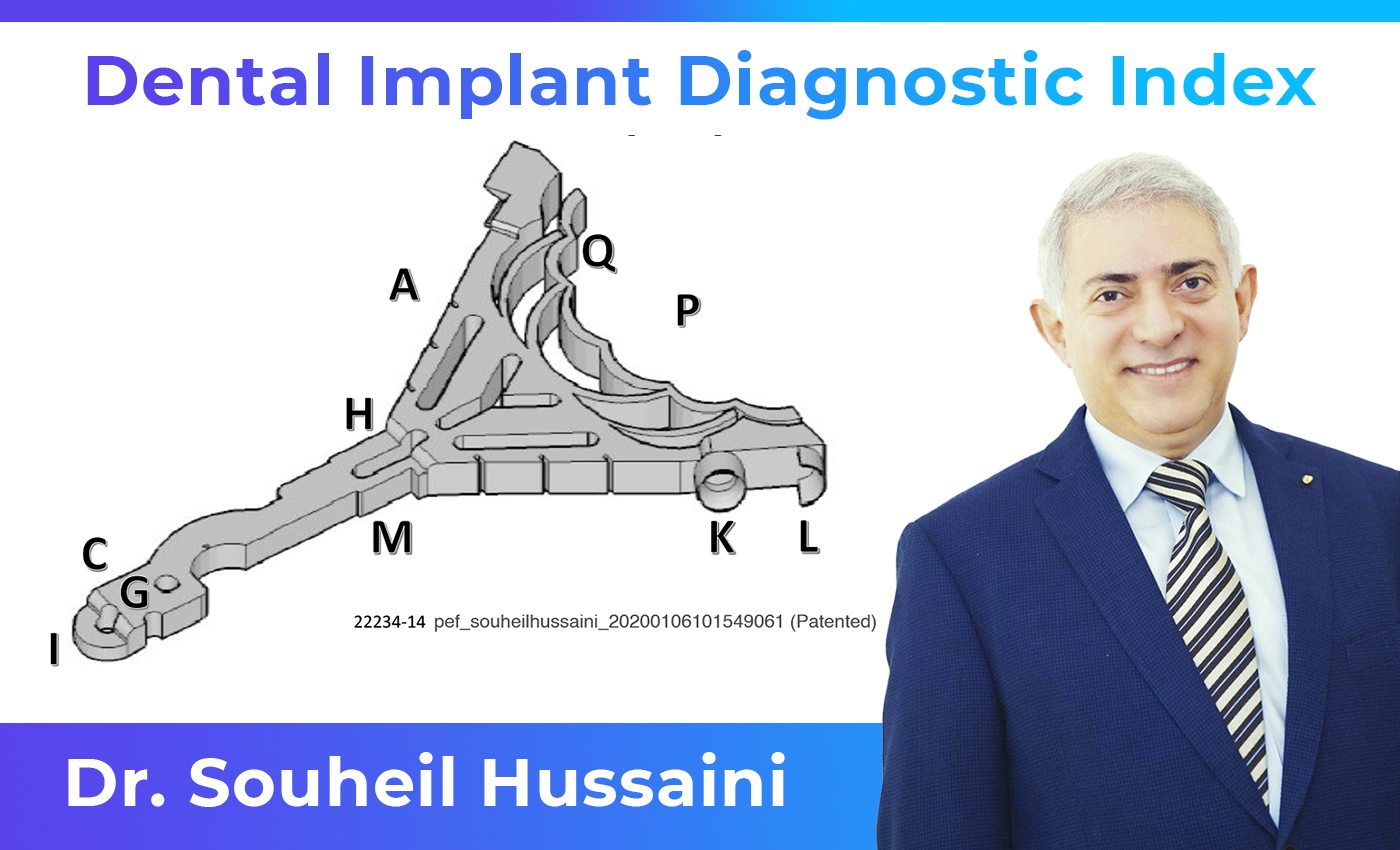
DIDI stands for Dental Implant Diagnostic Index, is a first of its kind tool invented by Professor Dr. Souheil Hussaini for the purpose of diagnosis and treatment planning during Implant Dentistry procedures. It is simple tool with multiple applications right from planning of dental implant to placement of prosthesis.
Virtual implant planning systems use software and data from Cone Beam Computed Tomography (CBCT) to assess bone quantity and virtual models for the design of the implant-retained prosthesis and drill guides. DIDI is a 3-dimensional tool which offers advantages of being able to be used in patient’s mouth and via software as well. To elaborate, in comparison to conventional software packages, this tool has an analogue and an exact digital item that can be used during planning and surgical procedures for dental implants.
What are the applications of DIDI tool ?
Here is an overview:
- Measures ideal position to locate, place and position the pilot drill
- Defines the incision line during uncovering
- Helps in planning restorative options – screw retained or cementable
- Gauge for mesiodistal spaces with 1-4 spaces for implant placement
- Gauge to check inter-implant and implant-tooth distance
- Indenting marker for flapless
- Template to the shape of labial surface of maxillary teeth – helps in space distribution, emergence profile
Detailed application of each of the component of the device are as follows:
- 4 mm gauge for accurately measuring the ideal position for placing, locating and marking the pilot drill position when placed next to a tooth for a 5 mm implant (1.5+2.5)
- An "H" shape marker used for Uncovery tool to accurately define the incision line.
- If kept vertically the 7mm gauge can indicate possibility of a cementable vs. Screw retained interocclusal space and hence the restorative options can be planned accordingly.
- 7 mm gauge for a mesiodistal edentulous space with a slot for single implant placement.
- 14 mm gauge for a mesiodistal edentulous space with 2 slots for 2 implant placements.
- 21 mm gauge for a mesiodistal edentulous space with 3 slots for 3 implant placements.
- 28 mm gauge for a mesiodistal edentulous space with 4 slots for 4 implant placements.
- A slot measuring 7-12 mm edentulous space with a center hole maintained for anesthesia, osteotomy & uncovery.
- The tip (sideways) is 1.5 mm to check the space between the implant wall and the tooth.
- 3 mm gauge (sideways) to confirm the space between 2 implants.
- 5 mm diameter full circle indenting marker for marking a flapless procedure. [2.5mm deep].
- 5 mm diameter 1/2 circle indenting marker, marking a cutting position to preserve the keratinized crestal tissue and place it buccally.
- 5 mm gauge to position pilot drill for a wide diameter implant 5.5+ next to a tooth.
- 5 mm gauge width to confirm insufficient mesiodistal edentulous space with minimal 1mm reduction on neighboring teeth or orthodontic treatment.
- A flexible labial curved surface of 6 average size maxillary anterior teeth in ideal proportion to visualize the labial surfaces of each of them, midline, space distribution of future teeth and the emergence profile. Upon pushing it curves more and takes the shape of the arch.
- A template to shape the outline of the labial surface of the 6 maxillary anteriors during immediate or delayed temporization.
- A guide for the 1st drill trajectory, to be in the center of the future crowns for the 6 anterior teeth
What is this 3D tool made of?
It is made of transparent plastic
Is it reusable?
Yes, it can be autoclaved and reused.
Is this a simplified device for guided implant surgery?
Yes, it is simplified method of guided implant surgery.
What are the advantages of DIDI?
- It is readily available any time the patient walks-in.
- It can be used directly in patient’s mouth and also in virtual form using the software.
- Reduces the time for planning of dental implant treatment.
- Cost – effective compared to the conventional guided surgery.
Is this product commercially available?
Yes, it is available for both distributors and clinicians.
Where to find the software details and purchase details for the tool?
Article compiled by - Dr. Ashwin P S


 Dentist Channel Online







Hailey - 8 months ago