
 Dentist Channel Online
Authors- Aous Dannan, Richard Donaca, Philipp Rausch
Introduction
The introduction of cylindrical endosseous implants to dentistry have had a significant effect on restorative treatment planning. These advances can also affect treatment planning for teeth requiring endodontic treatment. The long-term success of titanium osseointegrated implants in periodontally healthy patients has been documented in various studies. However, additional data are still needed to confirm the long-term predictability of dental implants in general.
Titanium as dental implant material
Titanium and titanium alloys are commonly used as dental implant materials. The process of integration of titanium with bone has been firstly termed by Brånemark as “osseointegration”.
Currently, most of the commercially available implant systems are made of pure titanium or titanium alloy. Titanium and its alloys provide strength, rigidity, and ductility similar to those of other dental alloys. Whereas, pure titanium castings have mechanical properties similar to Type III and Type IV gold alloys. Titanium and its alloys give greater resistance to corrosion in saline and acidic environments. However, even though titanium alloys were exceptionally corrosion-resistant because of the stability of the TiO2 oxide layer, they are not passive to corrosive attack. Moreover, one of the most renowned problems regarding titanium is hypersensitivity. Some reports have considered titanium hypersensitivity as a risk factor in dental implant failure. Even though titanium has been used as a biomaterial for more than 50 years, several reports have identified its potential toxicity. Sakellariou and colleagues reported postoperative spinal infection due to titanium spinal implants. Similarly, Hettige and Norris documented a case of mortality after a suspected fatal local allergic response of the brain to a titanium cranioplasty. Patients sensitive to metals such as nickel, aluminium, or cobalt appear to be more susceptible to titanium-hypersensitivity reactions, and special care should be taken in the selection of implant biomaterial for such patients.
Another relevant problem related to titanium dental implants is the potential fracture. Although fracture of dental implants is not a frequent phenomenon, it can cause unfavorable clinical results. Green et al. reported a fracture of a dental implant 4 years after loading. The failure analysis of this implant revealed that the fracture was caused by metal fatigue and that the crown-metal, a Ni-Cr-Mo alloy, exhibited corrosion. In another study, Yokoyama, et al. concluded that titanium in a biological environment absorbs hydrogen and this may be the reason for delayed fracture of a titanium implant.
Dental Ceramics
Porcelain has been used in dentistry for 100 years. Aesthetics is the major advantage of porcelain, and brittleness is its weakest point for load-bearing restorations. Therefore, porcelain-fused-to-metal restorations to make ‘‘metal-ceramic restorations’’ has been the first choice of prostheses to satisfy requirements for aesthetics, durability, and fit to the abutments.
Two main types of all-ceramic fixed dental prostheses systems are proposed:
The first system involves using a single material for full contour crowns. Reinforced glassy materials were successfully used to make single crowns for anterior and premolar regions. Innovatively, polycrystalline zirconia with improved translucency has been used for full-contour crowns in the molar region.
The second system is to fuse aesthetic ceramics, such as porcelain and other glassy materials, to frameworks made of high-strength ceramics instead of alloys. Dense sintered polycrystalline zirconia-based material is promising for frameworks of fixed dental prostheses.Industrial dense polycrystalline ceramics such as alumina, zirconia, and alumina-zirconia composites are currently available for use with CAD/CAM technology via a networked machining system. Yttrium partially stabilized Tetragonal Zirconia Polycrystalline (Y-TZP) shows better mechanical properties and superior resistance to fracture. Y-TZP has a high fracture toughness, from 5 to 10 MPa m1/2, and a flexural strength of 900– 1400 MPa. Positive clinical performance of Y-TZP has been recently confirmed through several reports.
Ceramics in implant dentistry
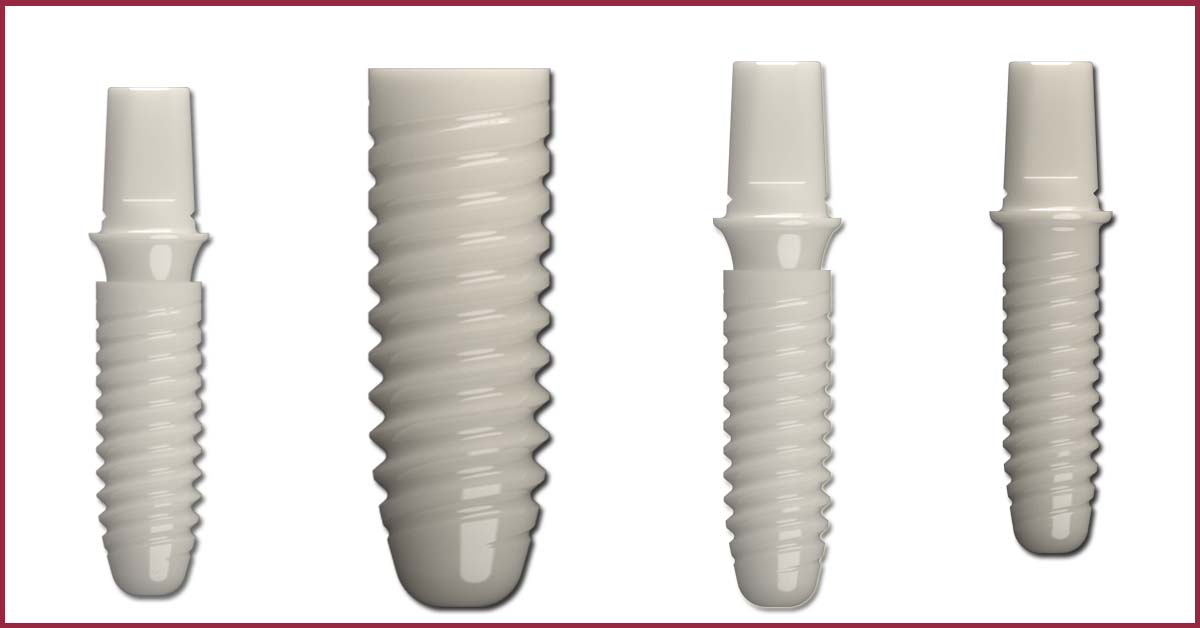
Due to the possible negative effects of titanium, as well as the positive features of ceramics, the clinical application of implants made from different novel ceramic biomaterials has become more active. Such ceramic materials include single- and poly-crystal alumina, bioactive glasses, hydroxyapatite, and zirconia. Furthermore, zirconium oxide coatings (approximately 100 nm) of Ti-6AI-4V, or titanium orthopedic implants, usually after the application of macro-texturing methods, may promote bone growth and thus provide evidence of enhanced implant osseointegration. Y-TZP is currently considered an attractive and advantageous endosseous dental implant material due to its high biocompatibility, improved mechanical features, high radiopacity, and easy handling during abutment preparation.
Zirconia ceramic is well-tolerated by bone and soft tissues and possesses mechanical stability. Since the difference in bone-to-implant attachment strength between bio-inert ceramics and stainless steel was not significant, it was indicated that the affinity of bone to bio-inert ceramics has almost the same capacity as metal alloys.
Vitro culture tests were performed to verify biocompatibility, genetic effects, and osteoblast interactions of potential zirconia implant substrates. A series of well-reviewed studies showed no adverse response, surface-specific and non-surface-specific proliferation, attachment and spreading of osteoblasts, and no genetic effect of zirconia on bone formation.
Animal studies that focused on zirconia implants without loading demonstrated comparable qualitative and quantitative characteristics to that of the titanium implants in biocompatibility and osteoinductivity.
Studies proved that micro-modification of Y-TPZ implants, resulting in a roughened surface, was beneficial for initial bone healing, bone apposition, and interfacial shear strength. Different studies were performed to define the feasibility of zirconia implant systems. A finite element assessment of the loading resistance revealed non-distractive and well-distributed stress patterns, similar to those of titanium implants.
More recently, Schepke et al. 2017 conducted a study to describe the histologic and histomorphometric features of a functional endosseous Y-TZP implant in a human subject. It was shown that the histologic data provided further evidence of the potential of such implants to osseointegrate to a similar degree as titanium in humans.
To date, there are several commercially available zirconia implant systems on the market. Some provide both one- and two-piece designs and the others provide only one-piece designs.Despite some promising preliminary clinical results, no clinical long-term data are available concerning zirconia implants. Survival rates after one year were reported at 93% (189 one-piece implants, Z-Systems), 98% (66 one-piece implants, Z Systems) and 100% (one-piece implants, CeraRoot). A notable review proposed that in an ongoing clinical study, TZP-A (ZrO2/Y2O3/Al2O3) experimental implants (n=119) with an especially roughened surface presented a survival rate of 96.6% after a 1-year observation period. However, clinical and laboratory research data were scarce on safe recommendations for a widespread clinical application of Y-TZP implants.
Mechanical tests for dental implants according to famous standards
In order to bring dental implants into markets, they should firstly pass several mechanical tests like fatigue and dynamical loading tests. These tests are mainly related to the ability of implant to withstand loading strength as a simulation to what is comparable to the oral cavity.
A number of publications underline the influence of the fatigue environment and synergetic corrosion fatigue on the performance of the materials, especially in the case of ceramic materials. Some studies indicated strong variations for the manuscripts available in literature, providing no information, 20 °C or room temperature (dry), 37 °C (dry, in water or saliva), or thermal cycling (usually 5 °C/55 °C) as testing conditions.
Loading tests for dental implants can be denoted according to predefined standards or norms (i.e. ISO, DIN, or EN).
For instance, DIN 50100 describes a load-controlled fatigue testing design at constant load amplitudes on metallic specimens and components. The endurance limit can be displayed, for example, in a Wöhler curve or in fatigue strength diagrams. However, this standard is not usually applicable for testing dental implants.
ISO13356:2015 specifies the requirements and corresponding test methods for a biocompatible and bio-stable ceramic bone-substitute material based on yttria-stabilized tetragonal for use as a material for surgical implants. This norm imposes that a maximum of 25 wt% of monoclinic phase is present in test specimens after an accelerated aging test (134◦C in a humid atmosphere with an air pressure of 0.2 MPa).
ISO DIN 14801:2016 (previously known as ISO 14801:2007) specifies a method of dynamic testing of single post endosseous dental implants of the transmucosal type in combination with their pre-manufactured prosthetic components and is used in 162 member countries around the world. It is most useful for comparing endosseous dental implants of different designs or sizes. This international standard is not a test of the fundamental fatigue properties of the materials from which the endosseous implants and prosthetic components are made, and, moreover, is not applicable to dental implants with endosseous lengths shorter than 8 mm nor to magnetic attachments.
While ISO 14801:2016 simulates the functional loading of an endosseous dental implant under “worst case” conditions, it is not applicable for predicting the in vivo performance of an endosseous dental implant or dental prosthesis, particularly if multiple endosseous dental implants are used for a dental prosthesis.
Critics and possible modifications regarding ISO standards for testing ceramic implants
Although ISO standards are equipped to encounter all possible loading situations that could take place in the mouth, they still lack more real conditions that should be taken into consideration. ISO 13356 prescribes the evaluation of test specimens with a simplified geometry (bending bars) and a polished surface. However, complex geometries as well as post-processing steps like micro-roughening to enhance osseointegration are known to significantly compromise the mechanical properties and, even more important, accelerate the aging kinetics. Therefore, ISO 13356 does not account for the real transformation rate of samples with roughened surface and a non-porous bulk, whereas ISO 14801 requires a dynamic loading procedure subjecting the implants to different loads, to finally obtain a fatigue resistance curve. Regrettably, only the latter standard evaluates the “market-ready” product but it misses to provide any environmental condition that induces aging.
Since complex geometries, manufacturing procedures and surface modifications of zirconia oral implants are known to compromise the original mechanical material properties and aging kinetics measured by the use of bending bars or discs, long-term thermo-mechanical loading in a hot aqueous environment of the finally designed implant should be mandatory before its market release. This method validates the functionality and safety of the product prior to the clinical application. Otherwise, the patient might be the one who suffers from potentially predictable early fatigue. In an important trial to enhance the testing conditions of ISO 14801, Castolo et al. 2017 tried to use finite element analysis to assess the influence of design parameters on the mechanical performance of an implant in regard to testing conditions of ISO 14801 standard. In their study, an endosseous dental implant was loaded under ISO standard 14801 testing conditions by numerical simulation, with 4 parameters evaluated under the following conditions: conditions of the contact surface area between the implant and the loading tool, length of the fixation screw, implant embedding depth, and material used for implant stiffness. Finite element analysis was used to compare the force that needed to reach the implant’s yield and fracture strength. It was shown that finite element analysis made it possible to evaluate 4 performance parameters of a dental implant under ISO standard 14801 conditions. Under these conditions, the contact surface area was found to be the major parameter influencing implant performance.
Numerical methods should be considered in the process of implants design, as they can improve the performance of dental implants and their prosthetic parts under the conditions of ISO standard 14801.
Conclusion
Titanium is regarded as the “gold standard” for dental implant materials due to its biocompatibility. Numerous studies have affirmed the high success and survival rates of titanium dental implants in many different applications. One disadvantage is that it can result in poor esthetics, especially in the anterior region, because of its greyish color and exposure of the implant body due to soft tissue recession or if the individual has thin gingival biotype. Moreover, some reports have considered titanium hypersensitivity as a risk factor for dental implant failure.
Zirconium implants appear to offer the similar success rates as titanium implants. Zirconium implants have an obvious esthetic advantage over titanium implants being “pure white”, making them indistinguishable from natural teeth.
Fracture, corrosion, fatigue, the possible abrasion actions that take place within the connected parts of implant, and other relevant terms are all important mechanical factors that should be taken into consideration before introducing ceramic dental implants in the market. Such mechanical features should be tested through previously defined standards or norms. To date, two separate international ISO standards are available for testing dental implants; namely ISO 13356 and ISO 14801.
However, there is still a recent debate regarding these currently applicable ISO standards since they are not addressing the in vivo aging behaviour of zirconia dental implants to verify their real pre-clinical safety.







Hailey - 8 months ago