
 Dentist Channel Online
Measurement of Dental Implant’s Osseointegration now Trouble Free and Wireless
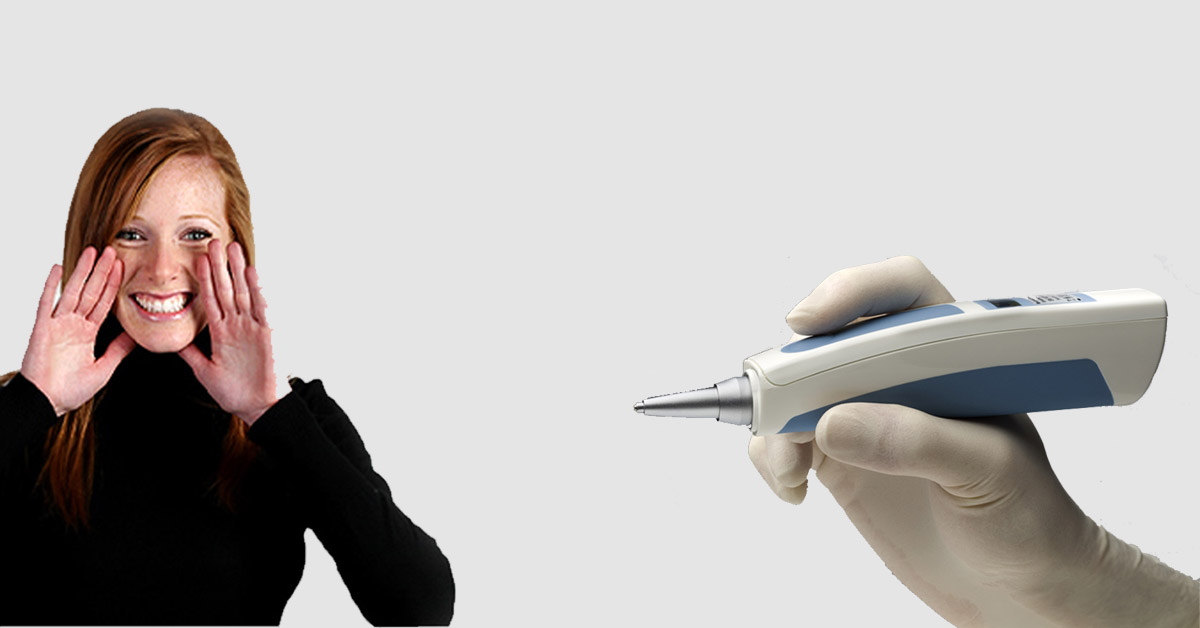
With the number of Implant Systems growing by the day a Measuring device specially designed for dental practises like the PERIOTEST M always comes to the Dentist’s rescue. Thanks to its Wireless Features, the Measurement of Dental Implant’s Osseointegration is now Easy peesy Lemon Squeezy! And its not only for the Measurement of Dental Implant’s Osseointegration but also helps in the Diagnosis and assessment of periodontopathies and assessment of the occlusal load and control of the treatment’s progress in the Natural teeth. The Periotest’s scale ranges from -8 to +50. The lower the Periotest value, the higher is the stability / damping effect of the test object (tooth or implant).
HOW DOES THE PERIOTEST WORK?
The Periotest measuring procedure is electromechanical. An electrically driven and electronically monitored tapping head percusses the test object (tooth or implant) 16 times. The entire measuring procedure requires approx. 4 seconds. The tapping head is pressure sensitive and records the duration of contact with the test object. Loose teeth or implants display a longer contact time and the Periotest values are correspondingly higher, while sturdy teeth or well Osseo- integrated implants have a short contact time and result in low Periotest values.
To ensure that the measurement is valid and meaningful, it is important to ensure that the handpiece is positioned correctly with respect to the test object (distance, angle). The device itself aids by monitoring all 16 impulses. Incorrect impulses are eliminated to ensure reliable and reproducible measurements.
Simple and Reliable Device indeed!
Assessment of the osseointegration of dental implants
PERIOTEST M can take measurements on most of the Implant systems in use. Moreover, measurements can be made at all stages of the implant process:
Directly after implantation
To measure primary stability, following the healing phase.
To determine that the required degree of osseointegration has taken place to enable pressure to be applied to the implant.
Following completion of the prosthetic, to enable any negative developments to be recognised at an early stage.
These Belwo table shows which Periotest value indicates good osseointegration and which are insufficient for withstanding pressure on the implant. As a result of the different implant systems and the existence of varying clinical conditions with individual patients, it is only possible to present guide values here.
Periotest Value Range Interpretation
-8 to 0 Good osseointegration; the implant is well
integrated and pressure can be applied to it
+1 to +9 A clinical examination is required: the application
of pressure on the implant is generally not (yet) possible
+10 to +50 Osseointegration is insufficient and no pressure
may be allowed to act on the implant
The irony is that, implants lose a certain amount of stability in the first 14 days following implantation, and this is reflected by an increase in the Periotest values of one to two units. However, once the healing phase is over, the Periotest values obtained will be like those which immediately follow implantation (primary stability). Significantly greater increases in Periotest values, even several years after implantation, are an indication that the implant has become unstable, one of its screws has loosened, or it has excess pressure or has become infected (e.g. periimplantitis). It is therefore advisable to record all measurements to allow monitoring checks to be conducted over time.
Diagnosis and assessment of periodontopathies
While the Periotest value closely correlates with the tooth mobility, it is not the result of a conventional measurement of the tooth. The following correlations apply:
Clinical degree of loosening Periotest value
0 -08 to +09
I +10 to +19
II +20 to +29
III +30 to +50
There’s various literature which helps one to study periodontium. There are also tables for use with natural teeth, that indicate which Periotest values can be expected for a healthy periodontium.
Early diagnosis of diseases of the periodontium
Incipient or existing periodontal structural changes, including occlusal traumas, can be determined with considerable accuracy during routine examinations – before they can be detected on a dental roentgenogram.
Monitoring of treatment by follow-up examinations
Objective, reproducible, and simple measurement permits the regular monitoring of the success of any periodontal, orthodontic, and functional therapeutic steps. The effect of occlusal disorders, and adjustment, can be evaluated objectively. Monitoring of prophylactic measures, e.g. following removal of dental calculus, teaching oral hygiene, and periodontal therapy. Reduction of the radiation exposure associated with the monitoring of treatment.
Help in decision making for further treatment
Rapid and objective determination of the suitability of a treated tooth for use as an anchor for further therapeutic measures. Periodontal reconstruction and orthodontic procedures can be quantified.
Detection of occlusal overloading
From the difference in the Periotest values during occlusion and in the absence of occlusion, occlusal overloading can be detected when this is greater than 6 Periotest values. This makes possible the immediate monitoring of occlusal adjustment in the case of almost all forms of occlusal treatments.
Periotest values are independent from such clinical parameters as condition of dental fillings, overlapping of teeth, presence of crowns or enamel defects.
The Periotest value, together with insertion torque and cortical bone thickness, could serve as an index of initial stability for predicting the outcome of miniscrew placement. Hence, the best device to determine the Measurement of Dental Implant’s Osseointegration is PEROTEST M.











Hailey - 8 months ago