
• Dentist Channel Online Dentist Channel Online
  • 1 April, 2022

Stainless Steel Crowns in Pediatric Dentistry 

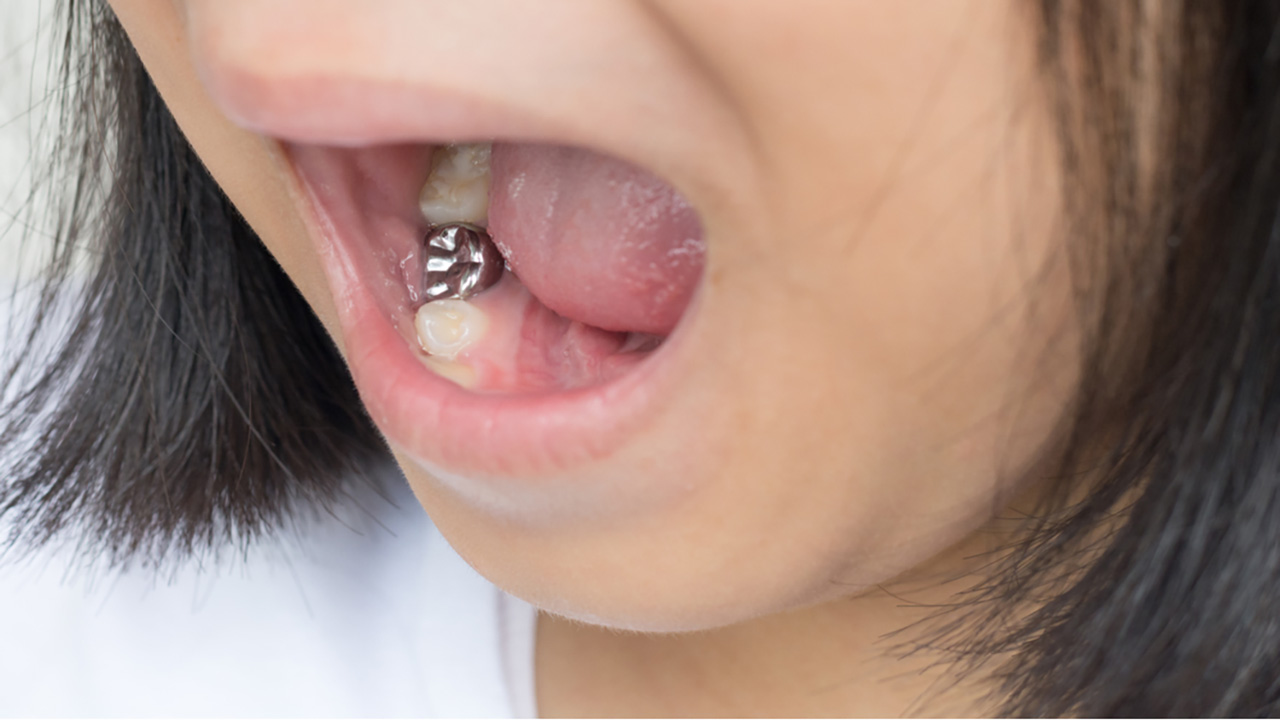
They are prefabricated crown forms that are adapted to individual teeth and cemented with a biocompatible luting agent. 

History

  • Introduced in 1947, by Rocky mountain company. 
  • Familiarized by Humphrey and Engel in 1950s.
  • Crown preparation was suggested by Mink and Bennet. 

Classification 

According to composition: 

  • 18/8 austenitic stainless steel 
  • Nickel- chromium crown 

According to position:

  • Crown for posterior teeth 
  • Crown for anterior teeth 

According to trimming: 

  • Untrimmed crowns
  • Pretrimmed crowns 

Objectives

  • To achieve biologically compatible, masticatorily competent and clinically acceptable restoration. 
  • To maintain the form and function where possible. 

Indications

  • Extensive caries. 
  • Rampant caries. 
  • Recurrent caries. 
  • Post pulp therapy. 
  • Inherited or acquired enamel defects.
  • Intermediate restorations.
  • Severe bruxism.
  • Abutment teeth to prosthesis.
  • As a part of Space maintainer. 

Contraindications

  • Primary molars close to exfoliation 
  • Primary molars with more than half the roots resorbed 
  • Teeth that exhibit mobility 
  • Teeth which are not restorable 
  • Patients with known nickel allergy 

Armamentarium

  • Crown cutting burs – pear shaped, tapering fissure, needle shaped, smoothening burs. 
  • Pliers – Hoe pliers, No 114 Johnson contouring pliers, No 417 crimping plier, No 112 Ball and socket plier. 
  • Scaler or any sharp instrument 
  • Crown and bridge scissors
  • Crown seater and remover
  • Stone and finishing bur
  • For cementation – luting cement, glass slab, spatula
  • Miscellaneous – Articulating paper, wax sheet, marking pencil 

Procedure 

  • Select the crown according to mesio distal diameter, proper occlusal height
  • Pick the crown with sterile tweezer 
  • Evaluate the occlusion 
  • Administer local anesthesia 
  • Occlusal reduction of 1.0 to 1.5mm with pear shaped head
  • Proximal reduction with needle shaped bur to beak contact and establish taper
  • Reduce and round off all line angles with finishing burs
  • Verify occlusion and proximal contacts
  • Try the crown on the tooth
  • Check the gingival margin, any excess needs to be trimmed
  • Smoothen the edges with finishing burs
  • Contour the crown
  • Crimping of the crown in gingival third
  • Finish the margins of crown
  • Mix and load luting cement on the crown
  • Seat the crown and ask the patient to bite firmly
  • Remove excess cement 


Article by Dr. Siri P. B. 
Categories:
Tags :
Comments :
Hailey Avatar
Hailey - 9 months ago
My name is Hailey Garcia and I am from New Jersey. My herpes virus turned to war after 2 years of living with it. I have tried different medical procedures to cure my herpes but to no avail. Most people think herpes is only a minor skin irritation of which herpes has long term effects on health and passes through the bloodstream and can be easily contracted through sexual intercourse. I knew I had herpes from the first day I started feeling itchy in my pubic area and the pain was very unbearable. I couldn't stand it anymore. After 2 years of trying other means to get rid of it, I had to contact Doctor Odunga to help me with a permanent cure. I saw his email and whats-app number from a testimony I read online from a lady who was also helped by him in curing infertility problems, I had faith and contacted him. He assured me of his work and I ordered his herbal medicine. Within 5 days, I didn't feel any pain anymore and within 2 weeks, my skin was all cleared and smooth. I am very grateful to you sir and I write this testimony as others have done to bring those having faith to you sir. If you have herpes or other similar disease and you want it cured, kindly contact Doctor Odunga, Whats-App (wa.me/+2348167159012) OR Email [email protected]

Authentication required

You must log in to post a comment.

Log in

Upcoming webinars:

  • 18 December,2025
Shoot, Document, Deliver: The Power of Dental Photography

Join our webinar ‘Shoot, Document, Deliver: The Power of Dental Photography’ to master equipment, techniques, and applications for impactful clinical images.

  • 21 December,2025
Minor Oral Surgery, Major Challenges : Clinician’s Guide

Gain practical insights into managing common challenges and complications in minor oral surgery for improved clinical outcomes.

  • 25 December,2025
From failing dentition to fixed function: Advanced full-arch implant restorations with a patient-centered approach

Discover advanced full-arch implant restorations transforming failing dentition with a patient-centered approach.

  • 28 December,2025
In the Loop : Decoding the Matrix Systems

Simplifying the matricing challenges from Flat to Fabulous

  • 1 January,2026
Management of Complications Post Transalveolar Extractions.

This Webinar will cover Management of Various Complications Occurring after Surgical Extractions.

  • 2 January,2026
Basics of Prosthetic Options in Dental Implants

Choosing the right prosthesis is the key to long-term success in implant dentistry.

  • 16 January,2026
Abutment Selection In Implantology- Which, When and Why?

This webinar will briefly discuss various abutment options and their selection process to enhance implant function and longevity.

  • 18 January,2026
Clinical Implications of Proximity of Nerve with Mandibular Third Molars

A Webinar on Evaluating Nerve Proximity Risks during Mandibular Third Molar Surgery for safer Clinical Outcomes.