 Dr.Melvin Mendonca,DBA,DJV
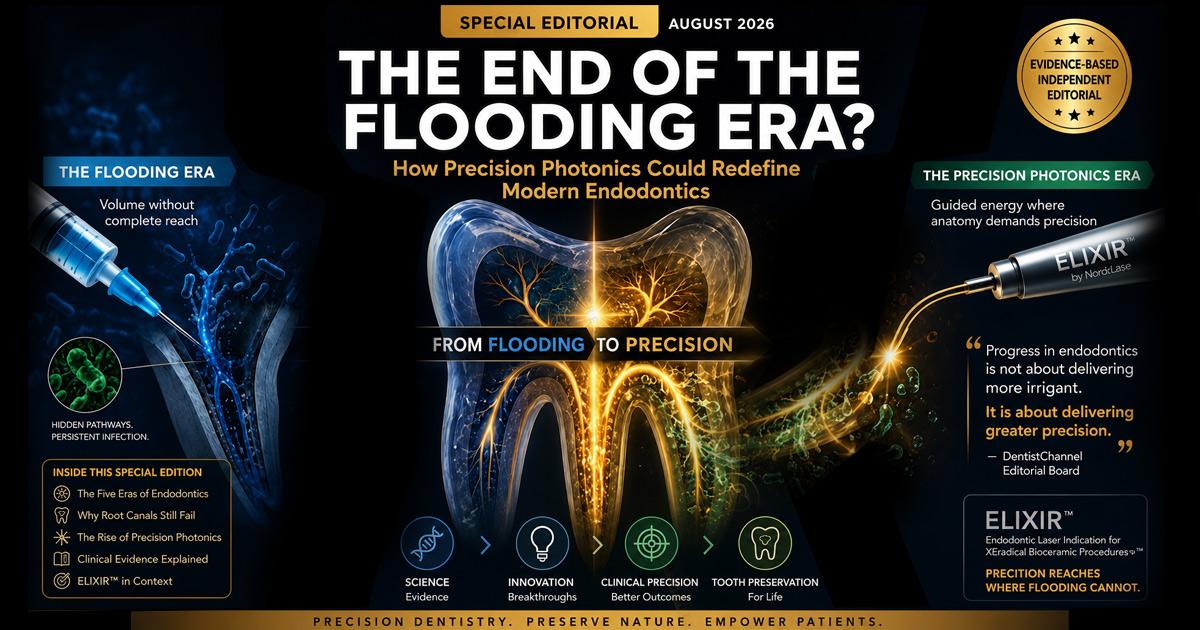
THE END OF THE FLOODING ERA?
How Precision Photonics Could Redefine the Future of Endodontics
A DentistChannel Special Editorial | August 2026
By the DentistChannel Editorial Board
For Nearly a Century, Dentistry Has Been Fighting the Same Battle
Imagine trying to clean an ancient underground cave system with nothing more than a garden hose.
No matter how much water you pump into the entrance, some hidden chambers remain untouched.
Now imagine shrinking that cave to microscopic dimensions.
That is the challenge every endodontist faces every day.
The root canal system is not a simple tube. It is a biological labyrinth of accessory canals, lateral canals, dentinal tubules, fins, isthmuses and apical deltas—an intricate network where bacteria can survive despite meticulous treatment.
For almost 100 years, modern endodontics has relied on one fundamental strategy to overcome this challenge: chemical irrigation.
Sodium hypochlorite, EDTA and activated irrigation systems have transformed root canal therapy and remain the gold standard of care.
Yet one important question still deserves to be asked:
Have we reached the limits of what flooding alone can achieve?
That question may define the next chapter in the evolution of endodontics.
The Root Canal Is Not Empty—It Is an Ecosystem
Every successful root canal treatment is ultimately a battle against one invisible enemy:
Biofilm.
Unlike free-floating bacteria, biofilms are highly organised microbial communities protected by an extracellular matrix that makes them remarkably resistant to antimicrobial agents.
The challenge is compounded by anatomy.
Studies have shown that the root canal system frequently contains complex structures that cannot be fully instrumented mechanically.
These include:
No rotary file—regardless of design—can contact every surface.
No irrigant—regardless of concentration—can guarantee penetration into every microscopic space.
This is not a failure of modern dentistry.
It is simply biology.
The Five Eras of Endodontics
DentistChannel proposes a simple editorial framework for understanding how the specialty has evolved. While not a formal scientific classification, it provides a useful way to appreciate the progression of clinical innovation.
Era One – Mechanical Beginnings
The age of stainless-steel hand files.
Success depended almost entirely on operator skill and tactile sensation.
Era Two – The Rotary Revolution
Nickel-Titanium instrumentation transformed canal shaping.
Clinicians achieved greater efficiency, improved centring ability and more predictable outcomes.
Era Three – The Irrigation Revolution
Dentistry recognised that shaping alone was not enough.
Chemical irrigation became the biological cornerstone of endodontics.
Ultrasonic activation, sonic devices and negative-pressure systems significantly enhanced irrigant performance.
Era Four – Digital Precision
CBCT imaging, dental operating microscopes, digital workflow and artificial intelligence dramatically improved diagnosis and treatment planning.
Dentists could now see more than ever before.
Era Five – Precision Photonics
Today, a new concept is emerging.
Rather than relying solely on increasing irrigant volume or activation, clinicians are exploring technologies that deliver precision energy into anatomically complex canal systems.
Laser-assisted endodontics represents one of the most exciting developments within this new era.
The Science Behind Precision
Light has transformed medicine.
From ophthalmology to dermatology and oncology, lasers have become indispensable tools for precision treatment.
Dentistry is following the same path.
Laser-assisted endodontics does not seek to replace conventional irrigation.
Instead, it seeks to complement it.
By delivering controlled photonic energy into the prepared canal system, laser technologies aim to improve microbial reduction and irrigant activation while respecting minimally invasive principles.
What Does the Evidence Say?
Innovation without evidence is merely speculation.
Fortunately, laser-assisted endodontics is supported by an expanding body of scientific literature.
A 2022 systematic review evaluating 48 published studies concluded that high-power laser-assisted disinfection significantly enhanced bacterial reduction when used alongside conventional chemomechanical preparation.
The review found particular promise with Er:YAG laser activation and diode laser systems, especially when combined with sodium hypochlorite irrigation.
Similarly, systematic reviews examining antimicrobial photodynamic therapy (aPDT) have demonstrated greater microbial reduction when laser-based protocols are added to standard root canal treatment.
Perhaps the most important conclusion appears consistently throughout the literature:
Lasers should be considered an adjunct—not a replacement—for proper instrumentation and irrigation.
This balanced perspective is essential.
Technology should enhance biology.
Not replace it.
From Flooding to Precision
One sentence captures this philosophy remarkably well:
"Precision Reaches Where Flooding Cannot."
It is more than a marketing slogan.
It reflects a broader shift occurring across modern healthcare.
Medicine is increasingly moving away from "more" and toward "better."
More cutting has become minimally invasive surgery.
More radiation has become targeted therapy.
More chemotherapy has become precision oncology.
Dentistry is following the same trajectory.
Precision, not volume, is becoming the defining principle.
ELIXIR™: A New Chapter in Laser-Assisted Endodontics
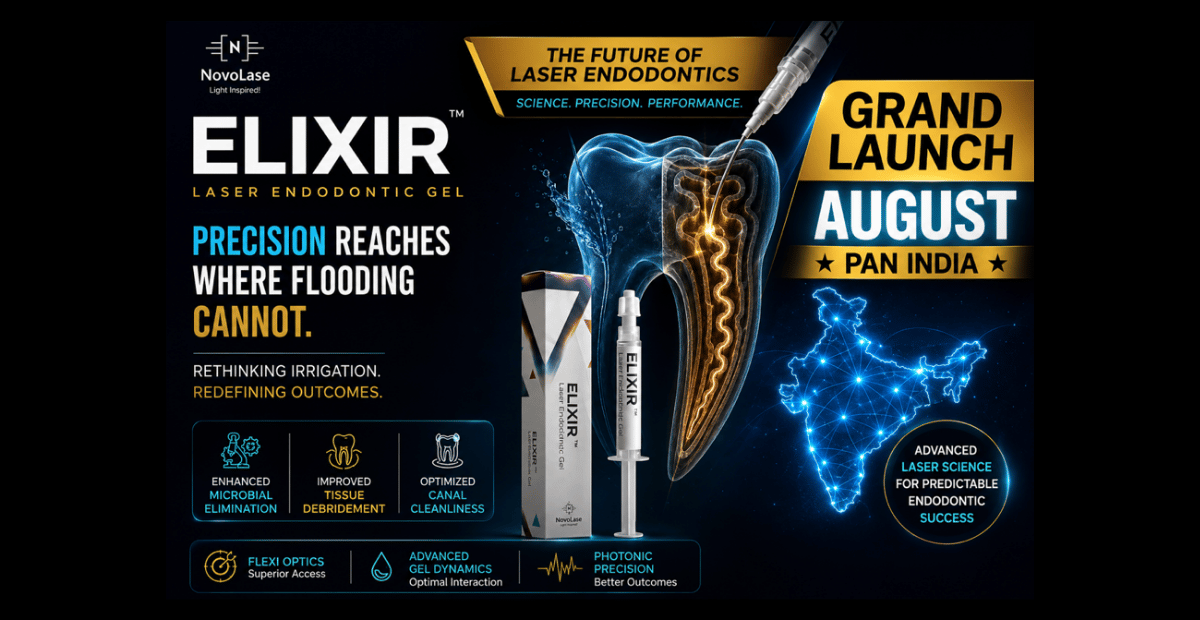
Against this backdrop, NovoLase, recognised for its commitment to dental laser innovation, introduces ELIXIR™ (Endodontic Laser Irradiation for Xtended Intracanal Reconditioning™).
Rather than presenting itself simply as another irrigant or another laser accessory, ELIXIR™ proposes an integrated concept built around three scientific principles:
Photonics
Controlled laser energy delivery.
Geometry
Flexible optical fibres designed for complex canal anatomy.
Rheology
Specialised gel dynamics intended to optimise laser interaction within the root canal.
Together these elements are designed to support enhanced microbial elimination, improved tissue debridement and optimisation of canal cleanliness.
While peer-reviewed studies specifically evaluating ELIXIR™ itself are still emerging, the broader scientific principles underlying laser-assisted endodontics are increasingly supported by systematic reviews and clinical research.
Why This Matters Beyond Endodontics
The implications extend beyond root canal treatment.
Successful endodontics preserves natural teeth.
Every tooth preserved is a patient who may avoid extraction.
Every avoided extraction may delay or eliminate the need for implant therapy.
Every preserved tooth supports the philosophy that modern dentistry should first seek to maintain what nature has already created.
This is not a competition between endodontics and implantology.
It is a partnership built on comprehensive patient care.
The Future Will Belong to Precision Dentistry
Artificial intelligence.
Robotics.
Digital workflows.
Regenerative medicine.
Laser-assisted therapies.
These innovations are not isolated trends.
They are converging toward a common destination:
Precision Dentistry.
The next decade will not be defined by who owns the newest technology.
It will be defined by who integrates technology most intelligently with biological principles.
An Editorial Perspective
At DentistChannel, we believe innovation deserves enthusiasm—but it also deserves scrutiny.
Every new technology should be evaluated through the lens of evidence, patient outcomes and long-term clinical value.
Laser-assisted endodontics has moved well beyond curiosity.
It is becoming an increasingly evidence-informed adjunct within contemporary endodontic practice.
The introduction of ELIXIR™ should therefore be viewed not simply as the launch of a new product, but as another milestone in the ongoing evolution of precision dentistry.
Whether ELIXIR™ ultimately becomes a defining technology will depend on continued independent research, clinical adoption and measurable patient outcomes.
That is exactly how meaningful innovation should be judged.
The Beginning of a New Conversation
Perhaps the greatest contribution of ELIXIR™ is not that it claims to solve every challenge in endodontics.
Rather, it encourages the profession to ask a different question.
Instead of asking:
"How can we deliver more irrigant?"
Perhaps the future lies in asking:
"How can we deliver greater precision?"
History suggests that progress rarely comes from doing more of the same.
It comes from seeing old challenges through a new lens.
The future of endodontics may not be written by flooding canals more aggressively.
It may be written by understanding how light, biology and precision can work together.
That conversation has already begun.
Discover More
To learn more about ELIXIR™, laser-assisted endodontics and NovoLase's educational initiatives, visit:
🌐 www.novolase.in


Learn how pediatric dentists can effectively screen, identify, and refer children with airway and sleep-disordered breathing for early intervention.