
• Dentist Channel Online Dentist Channel Online
  • 17 January, 2022

Basics of the Art of History Taking in Dentistry

The chronology of events that leads to a dental problem or tooth ache is called as dental history. The information received from the patient helps the dentist to arrive at a diagnosis and plan the treatment. The history should include past and present symptoms, as well as any procedures or trauma that might have evoked the chief complaint. Proper documentation is important to be safe from medicolegal issues. Often an S.O.A.P. format is used, designating the Subjective Objective Appraisal Plan for the diagnostic workup.

History of Present Dental Problem 

Involves dialogue between the patient and the doctor. The conversation helps to gather a lot of data from the patient regarding the purpose of visit to the doctor. The events should be recorded in a chronological event i.e. what occurred first and followed by other sequence of events that lead to dental problem. This helps the doctor in diagnosing the problem. The chief complaint of the patient should be recorded in patient’s own words 

Dental History Interview 

The dental history is divided into five basic directions of questioning: localization, commencement, intensity, provocation, and duration.

Localization – The doctor asks the patient to point out the offending tooth. Often the patient can point to or “tap” the offending tooth. This is beneficial to the doctor as it makes his work simpler. In addition, localization allows subsequent diagnostic tests to focus more on that particular tooth. It is important to observe the offending tooth as well as the surrounding tissues near the tooth of interest.

Commencement – The doctor asks when did the symptoms first occur. Initiating events can also be elicited from the patient. It may be spontaneous in nature, it may have begun after a dental visit for a restoration, trauma may be the etiology, or biting on a hard object may have initially produced the symptoms etc. Onset, intensity, nature, duration and the aggravating and relieving factors should be asked. Any other radiating nature of pain or associated symptoms should be asked by the doctor to the patient.

Provocation and Relief of Pain - What produces or reduces the symptoms is of main interest here. The patient may relate that drinking something cold or hot causes the pain or possibly that chewing or biting is the only stimulus that “makes it hurt”. The patient can also tell that medication is the relieving factor of pain.

Duration - Do the symptoms subside shortly, or do they linger after they are provoked is the main focus here. The duration of symptoms after a stimulating event should be recorded as to how long the sensation is felt by the patient, and documented in terms of seconds or minutes.

This gives an idea to the doctor regarding the dental problem. Dental history helps in gathering subjective as well as objective symptoms of pain by conversing with the patient and performing the necessary tests.


Article by Dr. Siri P.B.

Categories:
Tags :
Comments :
Hailey Avatar
Hailey - 1 year ago
My name is Hailey Garcia and I am from New Jersey. My herpes virus turned to war after 2 years of living with it. I have tried different medical procedures to cure my herpes but to no avail. Most people think herpes is only a minor skin irritation of which herpes has long term effects on health and passes through the bloodstream and can be easily contracted through sexual intercourse. I knew I had herpes from the first day I started feeling itchy in my pubic area and the pain was very unbearable. I couldn't stand it anymore. After 2 years of trying other means to get rid of it, I had to contact Doctor Odunga to help me with a permanent cure. I saw his email and whats-app number from a testimony I read online from a lady who was also helped by him in curing infertility problems, I had faith and contacted him. He assured me of his work and I ordered his herbal medicine. Within 5 days, I didn't feel any pain anymore and within 2 weeks, my skin was all cleared and smooth. I am very grateful to you sir and I write this testimony as others have done to bring those having faith to you sir. If you have herpes or other similar disease and you want it cured, kindly contact Doctor Odunga, Whats-App (wa.me/+2348167159012) OR Email [email protected]

Authentication required

You must log in to post a comment.

Log in

Upcoming webinars:

  • 19 June,2026
Periodontitis Masterclass: Hidden Truths Every Dentist Needs To Know

Explore the hidden truths of periodontitis, including diagnosis, prevention, and effective treatment strategies.

  • 20 June,2026
Minor Periodontal Surgeries

Practical, step-by-step approach to mastering common minor periodontal surgeries for predictable clinical outcomes in everyday dental practice.

  • 21 June,2026
Bite by Bite- Mastering Occlusion for Implant success

Through this webinar, Master the occlusal principles that make or break implant success - because the bite determines the life of your implant

  • 24 June,2026
Follow Your Hobbies to Destress

Discover how pursuing your hobbies can help reduce stress, improve mental well-being, and create a healthier work-life balance for dental professionals.

  • 27 June,2026
Dento-Facial Photography: The Future of Modern Dental Practice

Learn how integrating Dento-facial Photography can elevate diagnosis, communication, branding, and treatment planning in daily dental practice.

  • 1 July,2026
The Invisible Roadmap: Unmasking CBCT Pitfalls and Safe Zones in Implantology

Learn CBCT safe zones and avoid common pitfalls for predictable implant placement.

  • 5 July,2026
Margins don't lie- Mastering Final Impressions in Fixed Partial Dentures

Master precision in FPD impressions with practical clinical protocols, tissue management, and error-free execution.

  • 8 July,2026
Complications and treatment errors in peri-implant soft tissue management

Learn to identify, prevent, and manage common complications in peri-implant soft tissue treatment for predictable implant success.

  • 15 July,2026
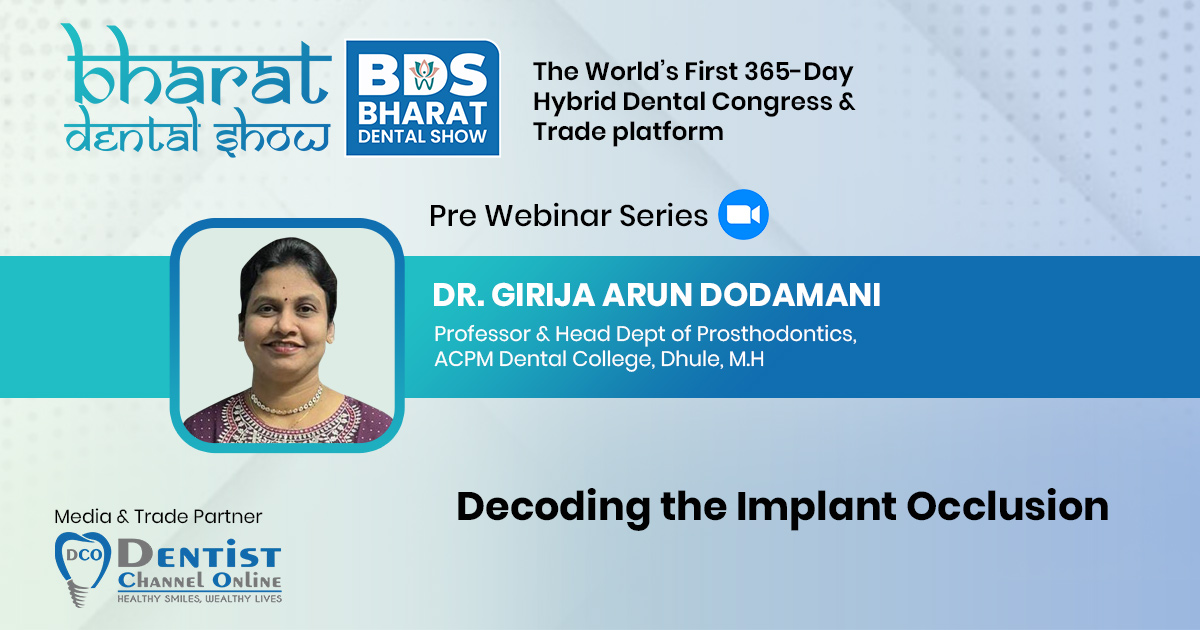
Decoding the Implant Occlusion

Master the principles of implant occlusion to reduce biomechanical complications and enhance the long-term success of implant-supported restorations.