
• Dentist Channel Online Dentist Channel Online
  • 29 April, 2022

Root End Filling Materials in Endodontics


The ideal retrofilling material should have the following characteristics: 

  • Capable of guaranteeing a perfect cavity seal 
  • Easy to carry and to manipulate 
  • Relatively fast setting time 
  • Dimensionally stable and nonresorbable 
  • Biocompatible 
  • Osseo and cementogenic 
  • Nontoxic 
  • Insoluble in tissue fluids 
  • Bactericidal or bacteriostatic 
  • Does not stain the root and the surrounding tissues 
  • Sterile or easily sterilizable before use 
  • Radiopaque 
  • Easy to remove if necessary 

Amalgam has been the most commonly used root-end filling material. Its use has been abandoned for many reasons, like toxicity, leakage,  corrosion,  blood mercury level,  tattoos on soft tissue,  microcracks in the root etc.  

Zinc oxide eugenol materialis an alternative to amalgam and it has been recommended as a root-end filling material because of its biocompatibility, marginal integrity etc. Eg. Super EBA 

Mineral Trioxide Aggregate is another material of choice. MTA was originally developed from Portland cement as a grey powder by Dr. Torabinejad (Loma Linda University, CA, USA). Advantages of this material includes biocompatibility, antibacterial properties, marginal adaptation and sealing properties, and its hydrophilic nature. 

Advantages of MTA includes:

  • Easy to mix and place into the cavity with a small carrier 
  • Since it sets in the presence of moisture, it is not moisture sensitive and is 
  • Not affected by blood contamination 
  • Seals better than amalgam, SuperEBA or IRM 
  • Has a better adaptation to the surrounding dentin 
  • Has excellent biocompatibility 
  • Activates regeneration of periapical tissues including periodontal ligament and cementum 

Difficulty of handling and staining caused by grey MTA and prolonged setting time are the disadvantages of MTA. 

Recently other bioactive tricalcium silicate and phosphate cements have been introduced, and EndoSequence Root Repair Material (RRM) (Brasseler USA, Savannah, GA, USA) is available. The first generation bioceramic used in dentistry has been MTA, which belongs to the category of tricalcium silicate-base cements. Recently other bioactive tricalcium silicate and phosphate cements have been introduced, and EndoSequence Root Repair Material (RRM) (Brasseler USA, Savannah, GA, USA) is available and populat in clinical use too. Biodentine is another well known root end material. 

Regardless of the size of periapical lesions, persistence of root canal infection is the primary cause of inflamed periapical tissues not to heal after endodontic therapy. 

 Article by Dr. Siri P. B.

Categories:
Tags :
Comments :
Hailey Avatar
Hailey - 1 year ago
My name is Hailey Garcia and I am from New Jersey. My herpes virus turned to war after 2 years of living with it. I have tried different medical procedures to cure my herpes but to no avail. Most people think herpes is only a minor skin irritation of which herpes has long term effects on health and passes through the bloodstream and can be easily contracted through sexual intercourse. I knew I had herpes from the first day I started feeling itchy in my pubic area and the pain was very unbearable. I couldn't stand it anymore. After 2 years of trying other means to get rid of it, I had to contact Doctor Odunga to help me with a permanent cure. I saw his email and whats-app number from a testimony I read online from a lady who was also helped by him in curing infertility problems, I had faith and contacted him. He assured me of his work and I ordered his herbal medicine. Within 5 days, I didn't feel any pain anymore and within 2 weeks, my skin was all cleared and smooth. I am very grateful to you sir and I write this testimony as others have done to bring those having faith to you sir. If you have herpes or other similar disease and you want it cured, kindly contact Doctor Odunga, Whats-App (wa.me/+2348167159012) OR Email [email protected]

Authentication required

You must log in to post a comment.

Log in

Upcoming webinars:

  • 14 April,2026
Dental Sleep Medicine: Next Blue Ocean in Dentistry

A webinar highlighting Dental Sleep Medicine and the dentist’s role in identifying and managing sleep-related breathing disorders like sleep apnea.

  • 15 April,2026
Breaking Silence: Social Health and Aging

A thought-provoking webinar addressing social health challenges, cultural taboos, and aging-related issues to improve holistic well-being in older populations.

  • 16 April,2026
Guided Endodontics for Calcified Canals – Predictability Redefined

A practical webinar on using guided endodontic techniques to improve predictability and success in managing calcified root canals.

  • 18 April,2026
Data to Decisions: Understanding Disease Measurement in Epidemiology

A webinar on understanding epidemiological disease measurement to interpret health data and support evidence-based decisions.

  • 19 April,2026
Endodontic Masterclass| Endodontics in Everyday Practice – Protocols That Work in Real Clinical World

A comprehensive online masterclass focused on practical endodontic protocols to help dentists achieve predictable results in everyday clinical practice.

  • 22 April,2026
Preserving The Aging Dentition -Restorative And Endodontic Considerations

Webinar on preserving aging teeth with effective restorative and endodontic care.

  • 24 April,2026
Clinical Periodontology: Decision-Making with a Periodontist’s Mindset

A webinar on clinical decision-making in periodontology using a periodontist’s diagnostic and treatment planning approach.

  • 25 April,2026
Timing is Everything: Early diagnosis and prevention of malocclusion and Dentofacial abnormalities in children.

Webinar on early diagnosis & prevention of malocclusion & dentofacial abnormalities in children for better long-term oral development.

  • 29 April,2026
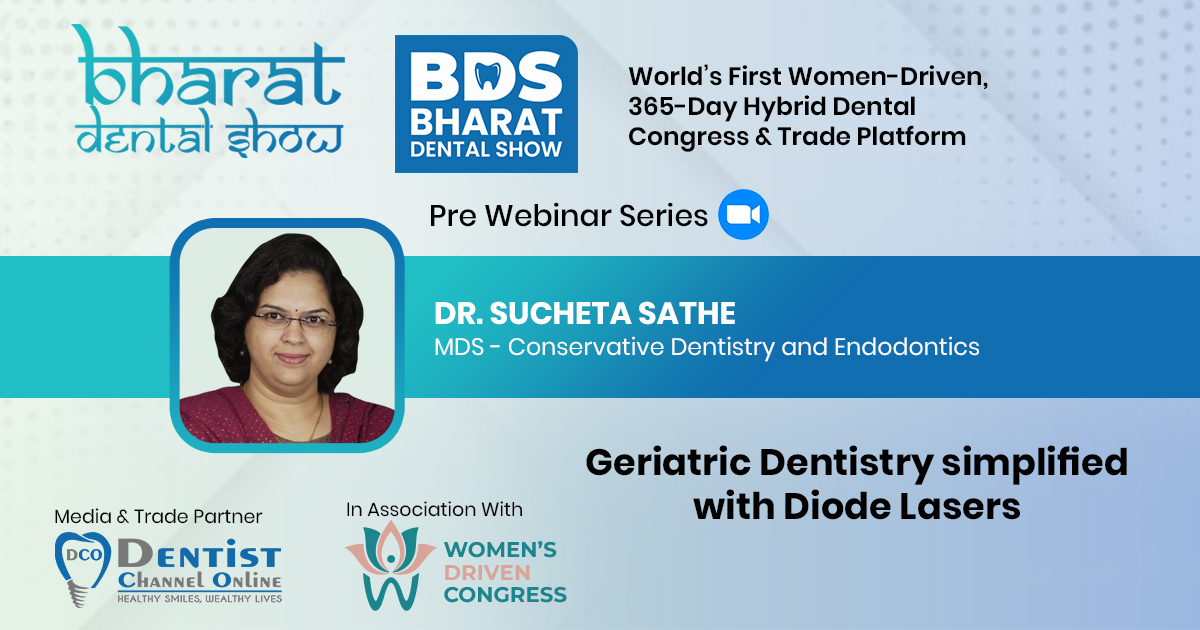
Geriatric Dentistry simplified with Diode Lasers

A practical webinar on simplifying geriatric dental care using diode lasers for minimally invasive, efficient, and patient-friendly clinical outcomes.