
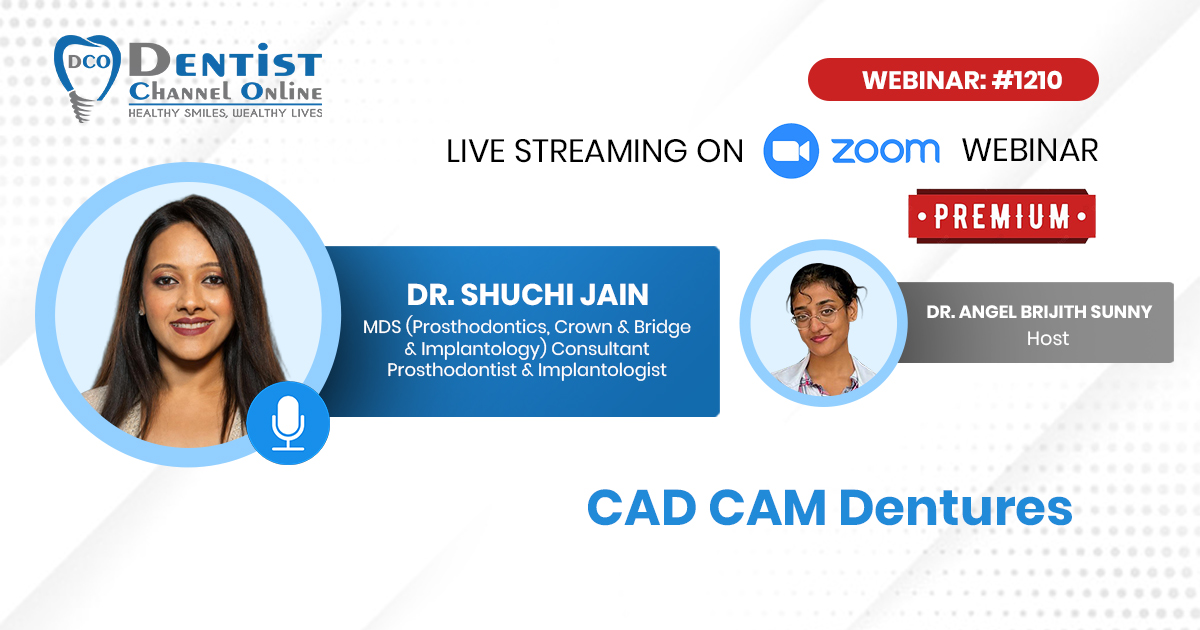
Certificate of participation with 1 CME is available
The advent of digital dentistry has significantly transformed conventional prosthodontic treatment approaches, particularly in the fabrication of complete dentures. Computer-Aided Design and Computer-Aided Manufacturing (CAD-CAM) technology offers an innovative and predictable approach to denture fabrication by integrating digital scanning, virtual designing, and automated manufacturing processes. CAD-CAM dentures are primarily fabricated using subtractive manufacturing (milling) or additive manufacturing (3D printing), providing improved consistency, dimensional accuracy, and reproducibility.
Compared to conventional denture fabrication, digitally fabricated dentures offer several advantages, including reduced clinical and laboratory appointments, improved fit and retention, enhanced material properties, reduced polymerisation shrinkage, and easy digital storage for future duplication. Milled dentures, particularly those fabricated from pre-polymerised polymethyl methacrylate (PMMA) blocks, demonstrate favourable mechanical properties and reduced residual monomer content. Additive manufacturing provides additional flexibility in design and material utilisation.
Despite these advantages, certain limitations remain, including high initial equipment costs, technique sensitivity, limitations in digital impression recording, and challenges in reproducing functional and dynamic soft-tissue details. Nevertheless, continuous advancements in intraoral scanning, artificial intelligence, digital workflows, and biomaterials are expanding the scope of CAD-CAM technology in complete denture prosthodontics.
CAD-CAM dentures represent a significant advancement towards precision-based, efficient, and patient-centred prosthodontic rehabilitation, with the potential to redefine the future of complete denture therapy.
CAD-CAM Dentures
1. Introduction to Digital Dentures: Evolution of complete denture fabrication from conventional to digital workflows.
2. CAD-CAM Technology: Understanding computer-aided designing and manufacturing in prosthodontics.
3. Digital Workflow: Intraoral scanning, conventional impression digitisation, virtual jaw relation recording and digital denture designing.
4. Milling vs 3D Printing: Comparison of subtractive and additive manufacturing techniques.
5. Materials Used: PMMA-based pre-polymerised resin blocks and 3D-printable denture base materials.
6. Clinical Advantages: Improved accuracy, retention, reproducibility, reduced appointments and patient comfort.
7. Digital Denture Design: Virtual teeth arrangement, occlusal adjustments, flange designing and border extensions.
8. Clinical Challenges: Limitations of intraoral scanning, recording functional borders and capturing dynamic soft-tissue movements.
9. Denture Duplication: Digital storage of denture designs for easy reproduction and replacement.
10. Future Perspectives: Artificial intelligence, advanced biomaterials and fully integrated digital denture workflows.
Key Takeaway -
CAD-CAM technology is transforming complete denture prosthodontics by improving workflow efficiency, standardisation and reproducibility while opening new possibilities for precision-based digital rehabilitation.
Date: 24/01/2027 |01:00 PM IST







Amanda - 1 day ago