
• Dentist Channel Online Dentist Channel Online
  • 2 April, 2022

Periodontal Ligament - Structure and Function


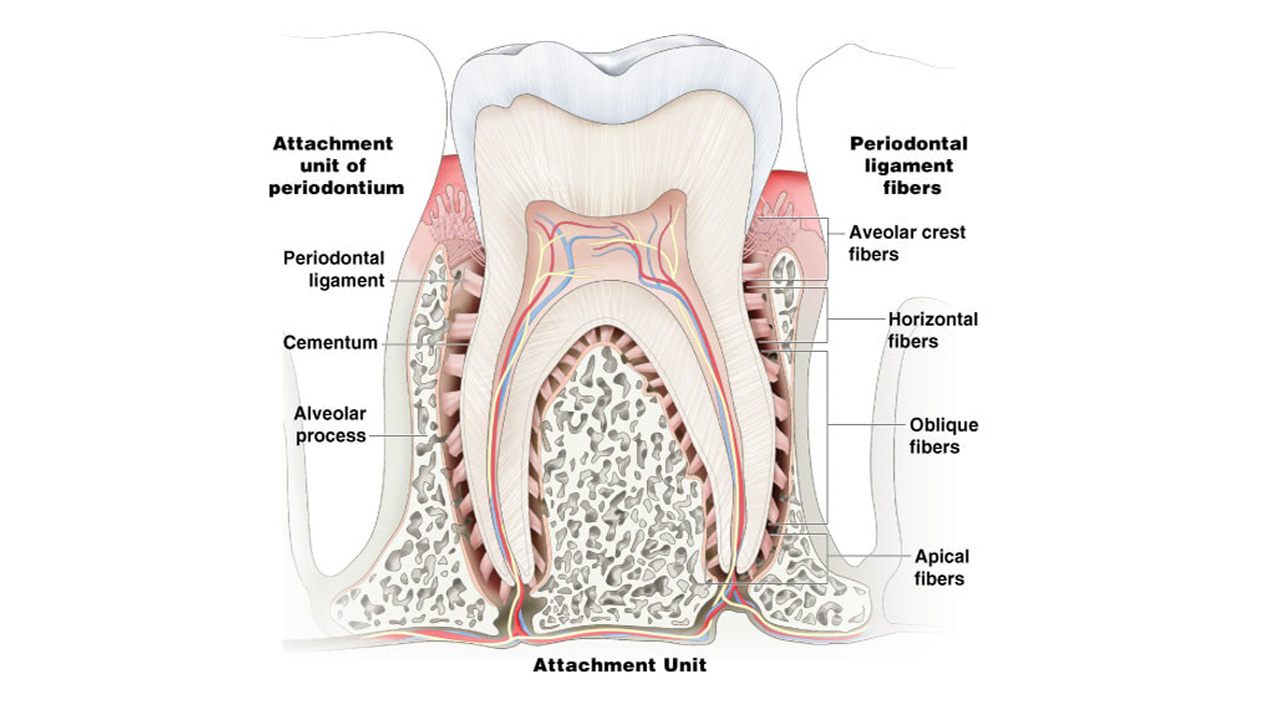
Tooth-supporting structures include, the periodontal ligament, cementum and alveolar bone. The periodontal ligament is a connective tissue structure that surrounds the root and connects it with the bone. The periodontal ligament space has the shape of an hourglass and is narrowest at the mid-root level. 

Periodontium has been divided into two parts: the gingiva, the main function of which is protecting the underlying tissues, and the attachment apparatus, composed of the periodontal ligament, cementum, and alveolar bone. Periodontal ligament in short is called as PDL. It is composed of a complex vascular and highly cellular connective tissue that surrounds the tooth root and connects it to the inner wall of the alveolar bone. Width of PDL is about 0.2 mm.  

Cells of periodontal ligament are categorized as -  

  • Synthetic cells – Osteoblasts, Fibroblasts, Cementoblasts. 
  • Resorptive cells – Osteoclasts, Cementoclasts, Fibroblasts. 
  • Progenitor cells. 
  • Other epithelial cells Epithelial cell rests of Malassez. 
  • Connective tissue cells Mast cells and macrophages. 

Extracellular Components includes –  

  • Fibers – Collagen, Oxytalan 
  • Ground substance – Proteoglycans, Glycoproteins 

Periodontal fibers: They are the most important elements of the periodontal ligament. It includes Trans-septal group, alveolar crest, horizontal, oblique, apical and interradicular fibres. They are collagenous and arranged in bundles. Small collagen fibers run in all directions along with the principal fibres, forming a plexus called the indifferent fiber plexus.  

The space between cells, fibers, blood vessels and nerves in the periodontal space is occupied by ground substance which is made up of glycosaminoglycans such as hyaluronic acid, proteoglycans and glycoproteins such as fibronectin and laminin. It contains around 70 percent water content.  

Structures present in the connective tissue are the blood vessels, lymphatics, nerve innervation and cementicles.  

Functions of Periodontal Ligament includes –  

  • Physical. 
  • Formative and remodelling. 
  • Nutritional and sensory function. 
  • Transmission of occlusal forces to the bone and resistance to the impact of occlusal forces (shock absorption). 
  • Maintenance of the gingival tissues in their proper relationship to the teeth and hold the teeth in position by attaching it to the bone. 

The primary role of periodontal ligament is to support the tooth in the bony socket. Periodontal ligament is shaped like an hourglass and since it is narrowest in the middle region of the root it seems to be the fulcrum of physiologic movement.  


Article by Dr. Siri P. B.

Categories:
Tags :
Comments :
Hailey Avatar
Hailey - 1 year ago
My name is Hailey Garcia and I am from New Jersey. My herpes virus turned to war after 2 years of living with it. I have tried different medical procedures to cure my herpes but to no avail. Most people think herpes is only a minor skin irritation of which herpes has long term effects on health and passes through the bloodstream and can be easily contracted through sexual intercourse. I knew I had herpes from the first day I started feeling itchy in my pubic area and the pain was very unbearable. I couldn't stand it anymore. After 2 years of trying other means to get rid of it, I had to contact Doctor Odunga to help me with a permanent cure. I saw his email and whats-app number from a testimony I read online from a lady who was also helped by him in curing infertility problems, I had faith and contacted him. He assured me of his work and I ordered his herbal medicine. Within 5 days, I didn't feel any pain anymore and within 2 weeks, my skin was all cleared and smooth. I am very grateful to you sir and I write this testimony as others have done to bring those having faith to you sir. If you have herpes or other similar disease and you want it cured, kindly contact Doctor Odunga, Whats-App (wa.me/+2348167159012) OR Email [email protected]

Authentication required

You must log in to post a comment.

Log in

Upcoming webinars:

  • 1 April,2026
Introduction to Geriatric Dentistry & Geriatric Oral Healthcare

Introduction to geriatric dentistry focusing on oral healthcare for elderly patients.

  • 3 April,2026
Magnification in Dentistry: Entering the World of Precision

A webinar exploring how magnification tools like loupes and microscopes enhance precision, visualization, and clinical outcomes in modern dentistry.

  • 5 April,2026
Mastering Abutment Selection: The Key to Implant Success

A focused session on selecting the right implant abutment to enhance prosthetic fit, function, and long-term implant success.

  • 5 April,2026
Healing The Wounds –Sutures & Suturing

A clinical session on sutures and suturing techniques for effective wound closure and better healing in dental procedures.

  • 8 April,2026
Pink of oral health for the silver age

A concise webinar on oral healthcare and management strategies for the elderly population.

  • 14 April,2026
Dental Sleep Medicine: Next Blue Ocean in Dentistry

A webinar highlighting Dental Sleep Medicine and the dentist’s role in identifying and managing sleep-related breathing disorders like sleep apnea.

  • 15 April,2026
Breaking Silence: Social Health and Aging

A thought-provoking webinar addressing social health challenges, cultural taboos, and aging-related issues to improve holistic well-being in older populations.

  • 16 April,2026
Guided Endodontics for Calcified Canals – Predictability Redefined

A practical webinar on using guided endodontic techniques to improve predictability and success in managing calcified root canals.

  • 18 April,2026
Data to Decisions: Understanding Disease Measurement in Epidemiology

A webinar on understanding epidemiological disease measurement to interpret health data and support evidence-based decisions.